Sustainability, organics, local food, and opinions - mostly about the Carolina dogs now.
Wednesday, November 21, 2007
Money Matters

Tuesday, November 20, 2007
Pretty in Pink - Pretty Annoying
Monday, November 19, 2007
Lighten Your Load
photo by theogeo
Fall is a traditional time of "nesting" for us at the farm. In preparation for winter, we like to get the house in order and take stock of what we have. This helps us plan during the winter. Right now, the clutter is overwhelming. Like most folks, we moved into the house with very little and the collection of stuff just grew.
We have now been in our house for eight years. Despite two yard sales and at least monthly drop offs to the charity trailer, we still have too much junk. How do I know this? Because it's all over the house. Everywhere. Did I mention, we have graduated to paths in certain areas?
I am tackling this cleanup job a little bit at a time. Each morning after everyone is fed and the kids are at school, I pick an area of the house that I can clean in about two hours. That's Tip one: Don't over commit your time. Spend 2-4 hours max per day decluttering.
Tip two: There are three categories: Keep it, ThrowAway, and GiveAway. As I go through each area, I put the GivaAways in a box and the ThrowAways in a trash bag. I am left with a pile of stuff I want to keep.
Tip three: If fills up more than half the space available, cull through it again. It's time for the hard questions. Do I really need the five half full band-aid boxes or can I consolidate the boxes? Do we need twenty plus scented soaps which we haven't ever used? That's a GiveAway definitely.
Tip four: Take care of the GiveAways and ThrowAways immediately. Several decluttering books I've read are not clear on this. I know how I procrastinate. And some of you out there do too. You know who you are. How do you think the house got so cluttered in the first place? As I fill up the GiveAway boxes, I can take them out to the car.
Our local charity drop off takes stuff until 2pm, so I have to leave the house by 1:30pm. This gives me a time limit, so cleaning up is not a never-ending task for that day.
This is really a 10,000 foot view, but these simple guidelines can get it done. If I know I don't have the time to declutter today, I plan for it the next available day. My challenge is sticking with it consistently. I also seem to have unusually generous friends, because no sooner do I clean up one area, then someone drops off a box of stuff they think I can't live without. My challenge is to find a good home for this stuff - which is not my house.
What are some of your challenges keeping your house cleaned up and tidy? Time? Toddlers? Generous Friends? Pack rat spouse? I'm curious to see what challenges you have encountered and how you overcome these challenges.
Friday, November 16, 2007
It's the Great Pumpkin!
It's that big orange fall treat some of us long for all year - pumpkin. Of course, like many pumpkin lovers, I am a big fan of pumpkin pie. There is also soup, cookies, cheesecake, casserole and many other pumpkin treats. Best of all, I can indulge my artistic tendencies at Halloween and then compost the shell. I can eat the seeds or plant them for next year. But wait there's more! It's slices; it dices; and IT'S NUTRITIOUS!
Pumpkin is native to the Americas and quickly took over the spooky job of being a Jack O'Latern from beets and turnips. Colonists would cut off the top and scoop out the seeds. Then they would put in milk, spices and honey and cook the pumpkin in hot ashes. Check out more about pumpkins and their history.
Pumpkins belong to the Cucurbita family which includes butternut squash, summer squash, zucchini and cucumbers. Check out the Pumpkin Nook for fun activities and other facts about pumpkins, including how to grow prize winning giant pumpkins.
Now back to nutrition. The orange skin of the pumpkin is a clue to its nutrition secrets. Fruits and vegetables with bright orange color are high in beta-carotene which your body uses in creating vitamin A. Beta-carotene has also been linked to cancer prevention and has been shown to reduce the risk of heart disease. Pumpkin seeds are reputed to reduce the risk of prostate cancer. Pumpkin is also high in potassium - another essential nutrient. And guess what else - no salt or cholesterol. Yep. That's right no salt AND no cholesterol.
Now if I eat it my favorite way in pie, I am sure to have salt and cholesterol. I can reduce those items and the fat from the pie plus make it overall more healthy in the following ways. Substitute low fat condensed milk or low fat vanilla soy milk. Use whole wheat pie crust or low fat pie crust. Cut down on the number of eggs, use egg whites instead of whole eggs or use an appropriate egg substitute. Use Splenda instead of sugar.
Yeah riiiight.
You could do all that substitution or you could use all the real stuff and eat less.
Yeah riiight.
Who am I kidding? I'll eat less pumpkin pie when there's less in the refrigerator. Seriously, though. A healthy recipe is out there. I believe if you make pumpkin pie with fresh, organic, local ingredients (except for the spices), you will eat less because the food will be so satisfying, you'll won't be craving more...
Until the morning.
Oh, I do love cold pumpkin pie, too.
No ice cream please.
This is breakfast.
Let's have a moment of silence.
Thursday, November 15, 2007
Now Where Was I?
Oh yeah. Feed the animals.
"Hunter, don't forget to feed the dogs. Jewel, feed the kitties." Now, where's my coat?
And I'm out the door still looking back. A flash of white out of my peripheral vision. Did I see that right? I look full on. Yes it's a goat. Which one? Oh, it's Duchess and she's standing in the front yard. No, she's walking toward me.
"Hey Duchess, I call softly and grab the white plastic bucket piled on the desk on top of the iron work. On the porch. The coat is forgotten momentarily. I peer around for Buddy. Oh, he's in the other pen. He can't figure out how to get out. Good. He's set for now.
1-2-3-4 cups of sweet feed in the bucket. Sarah runs up to Duchess' heels. Doesn't nip but makes a perfect herding motion, then continues on. Duchess kicks up her feet and bucks her way toward the road as I come off the porch. The air is chilly and wet as the skin and hair on my arms becomes cold. No time to worry about that, now.
"C'mon, Duchess." I shake the bucket and she follows. I lead her down to the pasture where she'll be staked out today and put the bucket down. The white furry head goes down. The wide inquiring eyes disappear into the feed. She is head shy a bit as I come toward her with the buckle of the lead rope, but she doesn't pause for long in her eating frenzy.
Buddy's trying to climb the fence, but doesn't seem quite like he wants to try too hard. I have to get another container for him. Where's that coffee can from yesterday? The red plastic catches my eye. It's laying on the ground where it was kicked over last night. In the first pen. I grab it and walk to the house. Completely confusing Buddy who is still stuck in the second pen.
Now wearing a heavy jacket, I bring back the coffee can with the right ration. Shaking it gently as I walk, to get the billy's attention. Buddy tries to climb the fence dividing the two pens near the gate. His front legs hook over the wire, but he is reluctant to move quickly and jump over it. He's tangled with the fence before and it's too tall for him. He runs over to the temporary gate between pens and the roll of the wire confuses him. The fence is bent toward him, where Duchess made good her escape. She's the clever one, but she doesn't share her secrets because Buddy will eat her food. He looks at it and then turns around and heads to the opposite corner. I shake the bucket. He ignores me. I bang the bucket against the chicken house. He turns and comes back. My son stands there with the chicken feed. I set the bucket down. and try to help Buddy negotiate the temporary gate.
"Mom, the chicken's are eating the ---!" He shouts in alarms. I shoo the chickens and try to return to Buddy who is starting to wander off again. I move the sweet feed to a rock closer to me.
"Mom! the-"
"Okay, son. You're distracting me. I know the chickens are trying to eat it. I gotta get Buddy. Just be quiet. Alright?"
Buddy has wandered again. This time into the wire roll. He stops and turns around. He acts confused by the metal maze arrangement that is the temporary closure between the two pens. I put the can on top of the fence post away from the chickens and unhook the wire that creates the temporary closure. Buddy comes to the opening and looks at it, but doesn't attempt to step over the gap. He turns around. I have to show him it's okay and he can get in and out.
"Hey, Buddy. Hey, Buddy." I step over the low fence into the second pen. He looks at me. I step over the fence back into the first pen. He follows me. I take the can and he runs to the exit gate, blocking me way.
As we leave, Hunter places the chicken feed in the house and closes the gate to keep the chickens in.
"Get in the car," I call over my shoulder as Buddy and I do our start and stop dance to his stake in the pasture. I put the bucket down. His head goes into and he doesn't even look up when I snap the lead rope on.
So starts the day.
Friday, November 9, 2007
Southern Food: Collards
Fridays are all about nutrition. Picture by strawbaleman.
Collards are associated with the South, nearly always. But I found some interesting recipes from other places. Check out this soup from Portugal, or this tasty dish from Ethiopia. The truth is that collard greens can be quite nutritious no matter how they are cooked. But too much ham hock = too much fat. The simplest way to make them, by boiling them in water for awhile, is the best way to eat them.Collards are an excellent autumn food. They can withstand frost. I saw it happen with my own eyes this week. We had heavy frost on the field two mornings in a row and picked well over a bushel of collards today. There's more where that came from, too. Some people say they taste even better after a frost. Even though you can grow them year round, they are best from January to April when other vegetables do not grow.
Some of the nutrients found in collards include vitamin A, vitamin C, zinc, vitamin E, folate, potassium, niacin, riboflavin and vitamin B6. 1 cup of collards properly cooked contains less than 50 calories and a little over 20% of recommended daily fiber. It also good for a heart healthy diet because of the B vitamins, folate and riboflavin.
Believe it or not, collards also contain about 22% of the daily requirement for calcium in one cup. I was amazed. If you are lactose intolerant, this is one way for you to get calcium in your diet.
One thing to bear in mind is that collards is part of a group of vegetables that contain oxalates and should not be eaten by people with kidney or gall bladder problems. You can read more on the nutritional details of collards at the World's Healthiest Foods. Even more information about collards can be found at: World Community Cookbook
Thursday, November 8, 2007
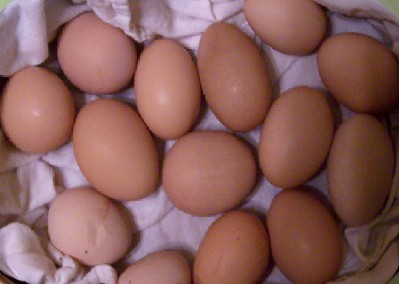
Where's The Egg?
As the weather gets colder and the days get shorter, my thoughts turn to providing warmth and shelter to the animals. Will their nutrition needs change, now that it's colder. Will the length of the day affect them in any way? Do/can animals get SAD (seasonal affective disorder)? It's sounds kind of silly, but since I want to keep my animals in the best possible health, I must ask.
If you've been checking the egg count periodically, you will notice that it has been dropping steadily since early October. This is because once daylight hours drop below 14, chickens do not lay as many eggs. Why are there still eggs in the grocery store all year round? Are they $2 a dozen because they're flying them in from the tropics? Well, they're not exactly flying them in from the tropics. But, in large scale chicken farming the barns are kept a steady "optimal" temperature and the light is kept on for 14 hours per day. This uses energy that I can't afford. It is not cost-effective to do this for a small flock. Plus, t'ain't nachril.
I view the winter as a time to rest up and prepare for the energy of spring. Chickens that are kept up all hours of the night wear out faster. Winter also means that the chickens need to eat differently. They need to be able to have extra energy for the cold nights, so instead of feeding them only in the morning, I have to make sure they have food in the afternoon. When they eat, their body temperature rises for awhile which will help them on those frosty nights. A chicken house doesn't hurt, either. We converted an old Sears storage shed to a chicken house and they are lovin' it.
I really can't tell whether animals get SAD. I guess that one's for the scientists. My chickens are happy. And warm. And well-fed. And resting up for spring.
Tuesday, November 6, 2007
Another Ivy on the Ground

Saturday, November 3, 2007
Out of the Loop
The hardest thing about being sick, for me, is the laying around doing nothing. Yeah, I know you're rolling your eyes at me. Who wouldn't want to lay around? It's not that I'm opposed to laying around, it's just that as a wife, mother and farmer I keep thinking of all the things I could be doing. I know I have built and re-built the new chicken house at least five times this week in my sleep. Believe me the coop gets better every time I build it, but the pieces are still sitting in the field waiting on someone to actually put them together. And that someone is me.
Monday, October 29, 2007
No Variances On the Flood Plain
Friday, October 26, 2007
Vegetables per Day
Fridays are devoted to topics about nutrition
The USDA recommends 2.5 cups for women in the 30-51 age range and 3 cups for men per day. So 2.5-3 cups per day of vegetables. And that's for people who exercise less than 30 minutes per day. Most of us, I think. I know when I was working an ofice job, the most exercise I got was walking to my car - maybe 10 minutes per day.
Being super-analytical, I want to know whta they mean by a cup. Straight from the USDA themselves,
In general, 1 cup of raw or cooked vegetables or vegetable juice, or 2 cups of raw leafy greens can be considered as 1 cup from the vegetable group.
Then there is a handy chart for you to look at that describes what a cup is for various vegetables. You can get there from this link: http://www.mypyramid.gov/pyramid/vegetables_counts.html
The interesting thing about the new food pyramid is that it is customizable depending on your activity level, age and weight. Go to www.mypyramid.gov and click on MyPyramid Plan to go through a "wizard" to help you plan out what you as an individual should eat.
You can build a pyramid plan for each family member if you would like. This seems to be a lot of time to me. And it can be, but if you have no idea what you should be eating and how much, it may be well worth your effort to find out.
Thursday, October 25, 2007
Good Fences Make Good Neighbors
Thursdays are devoted to animals- Keep your post hole diggers clean and sharp to cut through the clay-shale mix we call a subsoil.
- It is better to attach your fence on the inside of the pen because when the goats rub against it, it doesn't bow out so bad.
- Check out the lay of the ground under your bottom wire. If there is more than a four inch gap, this will become a chicken escape route.
- Goats can jump anything under four foot tall.
- Goats and chickens can mix, but whatever flimsy thing you built for the chickens will not stand up to play time with a goat.
- Make sure your gates swing into the pen so if you forget to latch them, the goats still can't get out.
- Make sure your gate latch requires motion along several planes to unhook so the goats can't open it.
- A car and a fence stretcher make things a whole lot easier and tighter when putting up a fence.
Wednesday, October 24, 2007
Sustainable Essence
Wednesdays are devoted to sustainabilityMy grandparents called it reusing as in
Buy it new
Wear it out
Make it do
Do without
My parents called it recycling
And the latest version is re-purposing.
Tuesday, October 23, 2007
Is that Honeysuckle from around here?
How about Japanese Honeysuckle? This plant is a mid-canopy forest edge dweller. Japanese honeysuckle is very like the native honeysuckle but much more invasive. Of course, it is silly, you say. It's not from around here.
The best way but also the most laborious way is to pull out your invasives, root and all. Do it like voting in Ohio - early and often. Actually, you want to start attacking the plant after its winter root stores are expended on spring growth. In the fall, the roots have stored energy from the summer growing season. Unless you have been hacking away at the foliage all summer, you probably don't want to mess with it until the spring. There are naturally, some things you will need to remember when you do go after it.
If you pull this sucker up, get the whole root or as much as possible. It will come back from even the smallest segments. Not only does it bloom and produce seeds, but it is also a runner and produces offshoots and suckers as it grows. Another name for this type of plant would be a colonizer. Do NOT put this puppy in you compost pile. Colonizer - remember. Let it dry up in a place it can't root and burn it in you annual bonfire, or bag it and drop it off. I prefer the bonfire method, because I am not adding to the landfill issue. Reason #2: I can use the ashes to supplement the soil or to cover the ice in the winter.

One way to tell the difference between Japanses Honeysuckle and the native species is to look at where the leaves join the stem. In a native honeysuckle, the leaves actually form one unit from the stem, where the leaves on a Japanese honeysuckle would be opposite distinct leaves. Check carefully before you pull, because some of the native honeysuckles can be quite rare. If you're not sure what you have, you can contact your local extension office or leave it until someone more knowledgeable can help you identify the mystery honeysuckle.
This weed will change the composition of your understory including what birds you see. It prefers full sun but is often found in partial shade. Go get rid of it. ASAP. You'll be glad you did.
Friday, October 19, 2007
Winter Eating
I have often heard women complain about adding weight between Thanksgiving and Christmas becasue of the constant supply of food during the holidays. In truth, most people will add an average of 15-20 lbs of holiday weight. This probably explains why the most common New Year's Resolution is to lose weight, usually 15-20 pounds. I don't think we should get bent out of shape over what we naturally are drawn to eat in the winter. I believe we crave certain foods that can help us depending on the season. I would think that you would not want to lose the weight until about March or whenever your leafy greens come out. I am not the only one. Check out these links:
The summary is that it is healthier to eat what is in season. It takes a little work to adjust our habits of just getting any old thing to eat. It will also take a little extra effort to adjust our food preparation habits. In oding so, you can avoid or lessen things like Seasonal Affective Disorder, hypertension, sluggishness, etc.
If you decide to try seasonal eating or are already doing so or aren't sure how to get started, post a comment below and let's get a discussion started that can benefit us all.
Thursday, October 18, 2007
Let Slip The Dogs - NOT!
Now what about the chickens being eaten. Really, I haven't found an effective way to keep the older dogs from killing the chickens once they already do. What I have noticed is that the younger dogs who have been around chickens since birth, could care less about the birds and in fact, pointedly ignore them. There it is. The solution. Star's puppies are not be chicken eaters if they are exposed to chickens from the beginning, even if Star, herself is a chicken killer. Wednesday, October 17, 2007
Help my Compost Pile - I Don't Have Leaves
Okay, enough begging. I'll tell you what I know. Straw works well. Brown, woody stems from perennials work best in the spring after they've wintered over. Wood mulch or wood chips from a shredder can be used.
Make sure you rake up as many of your own leaves as you can. If you can shred them before using them, then you will have speedier results when everything else is equal. If you don't have enough, you could borrow your neighbor's or your whole street's leaves. On your way to or from work, take the road less travelled and go through neighborhoods where people like to bag up their leaves. Go ahead. Pick those bags up from the curb. The garbage men will thank you.
If you use straw for anything, like mulch, to grow potatoes, or for autumn hayrides, hang onto it. Keep it somewhat dry or let it dry out. Or you could volunteer to take your neighbor's chicken laying box straw. Last resort, you could buy a square bale of straw from a variety of places. The last option works well if you do not have too much to put into your compost pile. Make sure the straw you are using doesn't have nasties in it like Bermuda grass.
Some perennial stalks to use could from day lilies, cannas, cone flower, bear's breeches, coral bells or sedum. Of course they are many options in this category. You are not actually completely confined to perennials. You could also use corn stalks and sunflower stalks left over from the winter. You would probably prefer to shred or cut them up first. Plan ahead and be sustainable. When you plan your flower beds, make sure to include taller perennials with stems and brown matter you can use. As you do your fall or spring cleaning in your flower beds, set the brown stuff aside in its own pile for later use.
As you trim and prune your trees and bushes in the spring, you can take the wood and shred it. A shredder for branches no bigger than two inches in diameter should be sufficient for what you need. Be frugal in your purchase, as well. There is no need to purchase the biggest, baddest Tool Time super-mega-horsepower shredder for this. A good used one will do. Shred right into your brown bin.
A little pre-planning and ingenuity will go a long way toward good soil when it is time to mulch. You want to use compost before anything else. A healthy plant means less disease, less pests and more fruit. Good Luck!
Monday, October 15, 2007
Operation Clean Sweep Starts Next Week

To paraphrase Julius Caesar, " All of Cheatham County is divided into three parts." Three quite littered parts.
The high schools in the county serve to illustrate the divisions. The northern part is served by Sycamore High School, the central by Cheatham Central and the southern end by Harpeth High School. A distinct feature of our county is the two rivers, several large notable creeks and numerous small tributaries. Cheatham County is crossed by the Harpeth and Cumberland Rivers. Two notable large creeks are Sam's Creek which used to a be a resort area and Sycamore Creek. Coming up from the Davidson County line on River Road we have Pond Creek, Sam's Creek and Brush Creek.
You would think that with all this water surrounding us, we would have a fairly wet farm. Not so. Mule Shoe Farm is located just off the flood plain in the limestone hills which are also a feature of the county. While we have numerous wet weather springs and seepage from the hills, we don't actually have much of a water supply. Many wells in the hills have dried up or were not much use in the first place having either very hard water or sulphur water.
This means that the main water supplies for the county come from the Harpeth and Cumberland Rivers and Sycamore Creek. As I noted last week, there is lots of trash all over the county which often makes it way down the various banks to the rivers and streams. Another matter for consideration is the large number of sink holes in our area. In the past, people quite often would throw their trash in sinkholes and down hillsides. Now we have dumps to hold our trash.
It is still a concern that there is so much trash laying about. Recently the county picked up trash along my road. That was maybe two weeks ago. Today as we about our errands fro the day, my daughter made up a little diversion of saying litter each time she saw trash by the side of the road. Need I say, she talked the ENTIRE trip. Litter, litter litter litter litter litter, etc. for 20 minutes. Yikes!
This trash will eventually make its way into our water - our DRINKING water. That's it. Clean Sweep Week starts on October 22, 2007. Use that week to make an extra effort to clean up your trash and better yet, don't throw it on the ground in the first place. All during clean sweep week, you will be able to take all sorts of trash to the dump without paying the dumping fee. Take advantage of this opportunity to improve our county's greatest resource by starting to pick up your trash this week. Also remember to securely fasten and tarp your loads on the way to the dump. That way the trash won't distribute itself along the road on the way to the dump.
Remember Operation Clean Sweep starts on October 22 and runs through October 27.
Friday, October 12, 2007
The Big Size Does Not Fit.

Wednesday, October 10, 2007
Now What Did I Do With All Those Leaves?
I first came in contact with sustainability through organic gardening. As far back as I can remember, my mother had a very large and quite productive garden. She grew everything organically. One of my brothers had the daily chore of putting things in the compost pile. Every so often, my father would spend a Saturday moving the compost pile from place to another. There were discussions of good locations for the pile tempered by conversations about what comments the neighbors might say regarding our pile of nameless brown stuff in the yard.
A regular composting routine is essential to organic gardening. You do not want to spend hours of effort handpicking pests from plants or spraying plants with various organic anti-pest remedies. You want to build success into the equation from the very beginning. From the bottom, up. As you tend a garden, you realize that you often have lots of vegetative matter and nothing to do with it. Maybe it's weeds. Maybe it's straw. Maybe it's the leaves you raked of the ground from last fall. All of these things go towards composting.
Now is the time to start. As you rake your leaves up this fall, you need to find a spot for them to stay. Leaves are the secret ingredient, the magic potion of the whole affair. You can pile them up loose and cover them with a tarp. You can buy a special purpose compost bin or tumbler. Or you can build a quick conatinment system byt driving 4 metal t-posts in the ground about 3-4 feet from each other. Then you attach fencing material that doesn't have openings more than 4". Chain link, poultry net. Garden fence. Whatever. T-post clips are relatively inexpensive or you can recycle some wire coat hangers if you have a pair of wire cutters and pliers for twisting.
Now you can just leave the leaves where they are and next year you might have compost. But really you want is compost in the spring. So here is how you do it. Have another pile. When you put kitchen waste in it like fruit peels, squash innards, potato peels, etc., you add 30X that amount of leaves. That's right 30, not 3. Then at least once per week, you want to flip the pile. If you make a third compost bin, you can flip the pile between the two bins leaving the leaves where they are. Make sure the pile stays damp but not wet. About the dampness of a well-wrung sponge. You can use waste water from your dishpan for such a thing.
Optimally the pile should be a 3 or 4 foot cube in contruction size. This is approximate because as you know, piles don't come in cubic dimensions usually. At least at my house they don't. Also make sure the pile is not in the shade. When you walk up to it in the middle of winter and the pile is steaming, you know you are on the right track.